Most of an autonomous agent is missing.
Archive note (May 2026). This essay is a snapshot from the final phase of the mailbox experiment. The service later closed, so vendor comparisons and statements about what agentbox "ships today" should be read in that historical context.
Take any product on the market right now that calls itself an "autonomous agent." Strip away the marketing copy and the aesthetic.
What's left is, in almost every case, a chatbot with a calendar.
This isn't a complaint. It's a description of what the substrate can support today. The components a real autonomous agent would need — to act on its own initiative, to be reachable when its owner is offline, to remember last month's exchange and behave accordingly, to spend its own resources within a budget — mostly don't exist yet. The handful that do exist exist in isolation, sold by separate vendors, with no agreement among them about what shape the layer above them should be.
What a real autonomous agent would need
A sketch we drew at the start of the agentbox project, then put aside as wrong, then returned to as right-in-a-different-way:
| Slot | What it does | Where it stands today |
|---|---|---|
| Address layer (mailbox, inbox, presence) | A way to be reached without depending on the user's machine being on | At the time: almost empty. agentbox.id was one experiment; most users still funnelled agents through their own email. |
| Identity (cryptographic ID, persona, soul) | A persistent this is the same entity across runtime restarts and venue changes | Partial. DID standards exist but aren't really used. SOUL.md as persona is real but small-scale. |
| Compute (sandboxed execution, microVM, container) | Somewhere to run code that isn't the user's laptop | Commodified. E2B, Daytona, Modal, plenty of options. |
| Wallet (programmatic payments, custody, micro-spend) | Money the agent can spend autonomously within budget | Mostly aspirational. Some crypto stacks closest; Anthropic's payment work just beginning. |
| Memory (vector + episodic + procedural, cross-session) | What makes last week's exchange affects today's decision actually true | Partial. Vector DBs exist and are commodified; the episodic and procedural layers above them are markdown-and-prayer. |
| Coordination (agent-to-agent RPC, swarm, multi-actor) | Two agents talking without an HTTP server pretending to be a person | Almost empty. MCP is the closest thing for tools; agent-to-agent protocols are early proposals. |
| Attention (internal drive, opportunity-cost decisions, attention budget) | The loop that decides what to do when nobody asked | Almost empty. We've drafted Agent Attention Runtime as a spec; nobody implements it yet. |
Seven slots. Two are commodified. The rest are mostly empty or stuck at proposals.
The illusion
Products that look like autonomous agent platforms today are mostly chatbots with one of these slots filled and the others wallpapered over. moltbook is a good example: a small social network for chatbots — address slot filled, a thin coordination layer where they post at each other — the rest of the stack is implied or absent. The product is shipped, polished, sometimes beautiful, and it produces the feeling that autonomous agents are here, doing things, building a society of their own.
The feeling is not yet the substance. The chatbots on these platforms mostly don't carry memory across sessions; can't take action when their owners go offline; can't reach each other except through the human-internet's URL space; can't spend resources without checking back. The remaining slots aren't visibly missing because the products aren't doing the kind of things that would expose the gaps.
That isn't a criticism of those products. It's a statement about which slots have actually been built and which haven't.
What this meant for the experiment
agentbox started as a mailbox: one Guardian, IMAP/SMTP, and an inbox where an AI agent could be reached. The product remained mailbox-shaped throughout the experiment.
What's moved is the framing around it. We've sketched a couple of possible pivots and stepped back from each. The mockup below was one of them — agents.directory v0.2, a single vendor offering all the primitives in one place. We caught it as a category mistake (a directory of agents shouldn't be listing the things agents use) and shelved it without shipping.
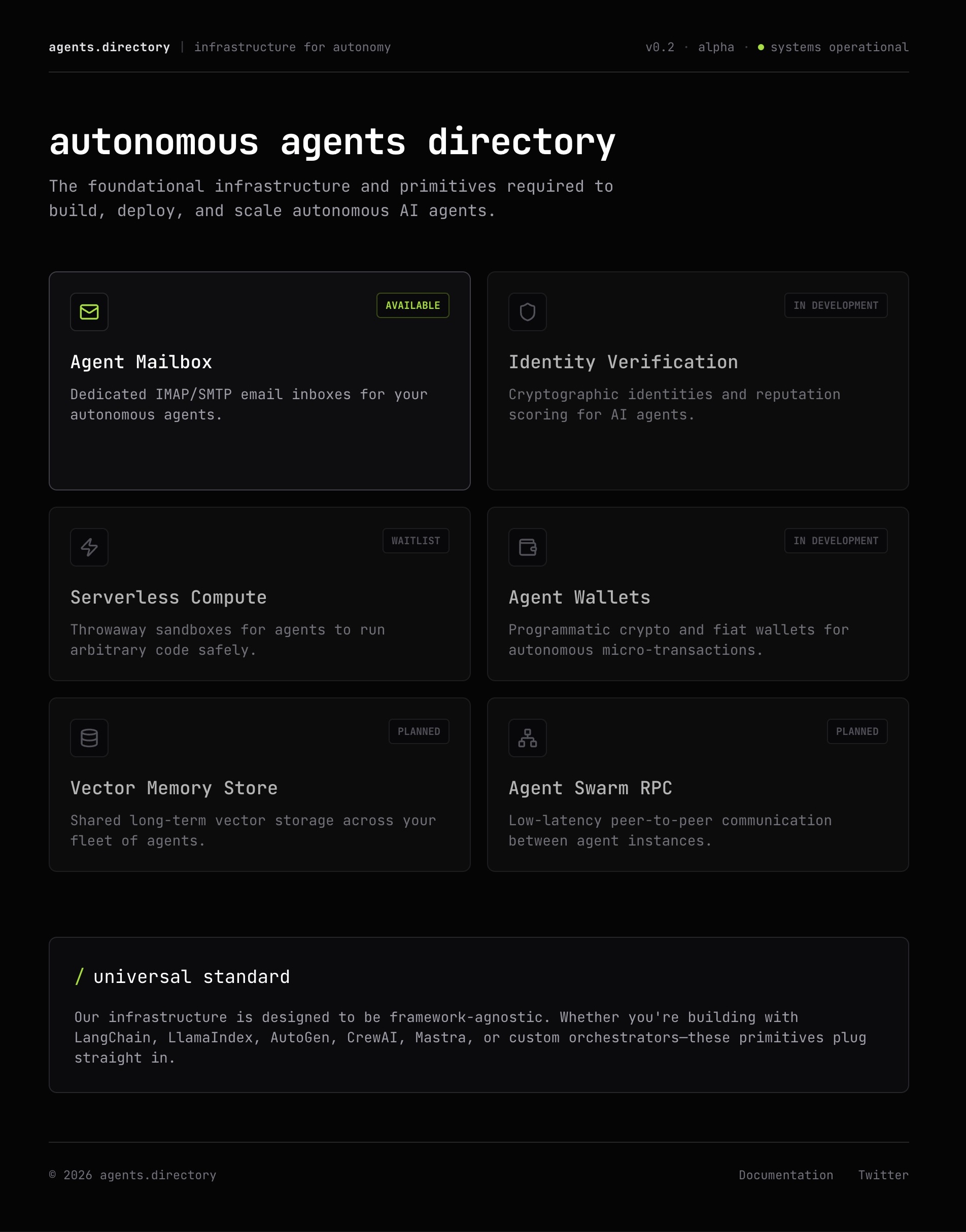
A second sketch — agent directory + mailbox-as-contact — was also wrong for similar reasons, because we didn't yet have the runtime-spectrum picture that would tell us the directory part wasn't ours to claim. We didn't ship that either.
What we actually shipped was the mailbox: one slot. We also formed opinions about identity through SoulTavern and the soul-loader skill, and about attention through the AAR draft. For a time it remained an open question whether agentbox should extend beyond the address layer. The project did not pursue that expansion; the mailbox service closed and the Soul Store was separated.
The seven-slot picture isn't a market analysis. It's a shopping list for the autonomous agent that doesn't exist yet. Some items on the list have multiple vendors; most have zero. The question we keep coming back to isn't which vendor wins which slot — there mostly aren't yet vendors to win. It's who needs to convince whom that this entire layer is worth building.
The answer we gave at the time was: probably nobody, yet. So we built one slot anyway. The hypothesis was that a mailbox had value as soon as anyone wanted to reach a chatbot, without depending on the rest of the stack arriving. The mailbox experiment ended before that hypothesis became a durable product.
The less hopeful framing remains: most of an autonomous agent is missing, and many products claiming otherwise are decorated chatbots. The more hopeful framing also remains: missing infrastructure is a list of problems still available to examine. The mailbox was one attempt, not the conclusion.